
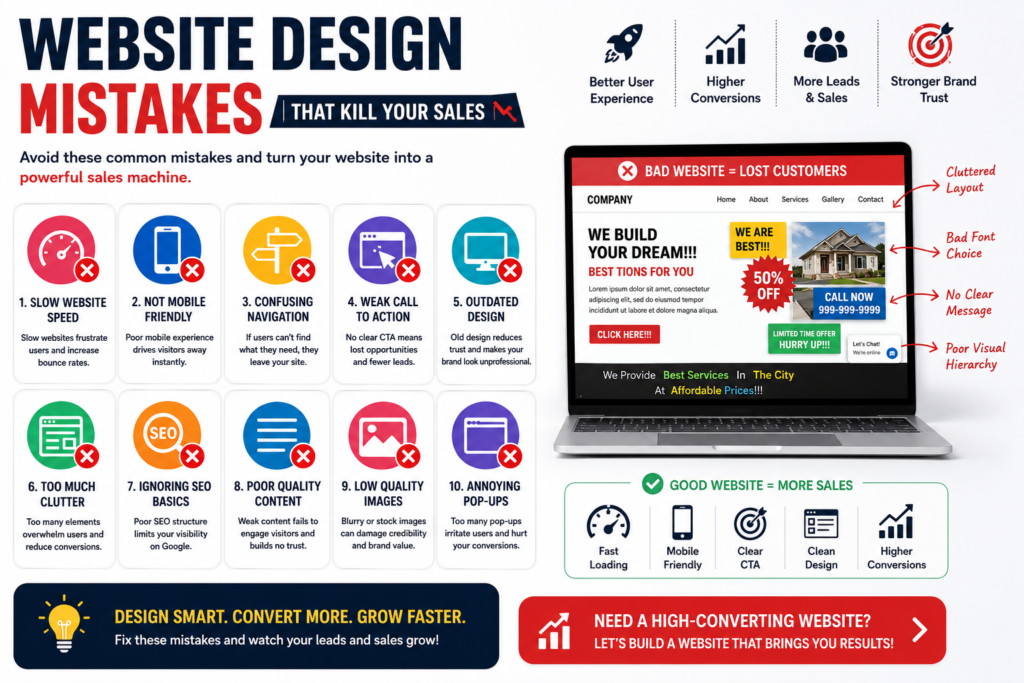
Website Design Mistakes That Kill Your Sales in 2026
Introduction
Website design mistakes,In today’s digital world, your website is often the first impression customers have of your business. Before people contact your company, purchase a product, or book a service, they usually visit your website to learn more about your brand. This is exactly why website design mistakes can seriously damage your business growth and reduce sales opportunities. Many businesses spend thousands of rupees on marketing campaigns but still fail to generate conversions because their website creates a poor user experience.
Modern customers expect fast, professional, and easy-to-use websites. If a website looks outdated, loads slowly, or feels confusing, visitors leave within seconds. Businesses often focus heavily on traffic generation while ignoring the actual experience customers have after landing on the website. This is one of the biggest reasons businesses struggle online in 2026. Understanding the most common website design mistakes can help businesses improve customer trust, increase engagement, and generate more sales consistently.
Slow Website Speed Reduces Customer Conversions
One of the biggest website design mistakes businesses make is ignoring website speed. Customers today have very short attention spans. If a website takes too long to load, visitors usually leave before even exploring the content or services.
Google also considers page speed an important ranking factor for SEO. Slow websites not only frustrate customers but also struggle to rank higher on search engines. Businesses with slow-loading pages often experience higher bounce rates and lower conversions.
Fast websites improve user experience, customer engagement, and overall sales performance. Businesses should optimize images, reduce unnecessary plugins, and use reliable hosting services to improve website speed. In 2026, speed is no longer optional — it is essential for online success.
Poor Mobile Optimization Hurts User Experience
Most internet users now browse websites through smartphones. Despite this, many businesses still fail to optimize their websites for mobile users. A website that looks perfect on desktop but performs poorly on mobile creates a frustrating customer experience.
Mobile users expect responsive design, fast loading times, easy navigation, and readable content. If customers constantly zoom in, struggle to click buttons, or face layout issues, they are likely to leave the website immediately.
This is one of the most damaging website design mistakes because mobile traffic dominates online browsing in 2026. Businesses with mobile-friendly websites naturally improve customer engagement and conversion rates.
Confusing Navigation Pushes Customers Away
Customers should never struggle to find information on a website. Complicated menus, cluttered layouts, and confusing navigation often frustrate users and reduce sales opportunities.
Visitors want quick access to products, services, contact information, and pricing details. If a website feels difficult to navigate, customers usually leave and search for competitors instead. Clear navigation improves customer experience and increases the chances of conversion.
Businesses should keep menus simple, organize pages logically, and make important sections easy to access. A clean and structured website design helps customers stay longer and interact more with the business.
Weak Call-to-Action Reduces Sales
Another major website design mistake businesses make is failing to guide customers toward action. Many websites provide information but never clearly tell visitors what to do next.
Strong call-to-action sections encourage users to contact the business, request a quote, schedule a consultation, or make a purchase. Buttons like “Contact Us,” “Get Started,” “Book Now,” or “Request a Free Consultation” help guide customer behavior.
Without proper call-to-action elements, websites lose valuable conversion opportunities. Businesses should place clear and attractive CTA buttons strategically throughout the website to improve lead generation and sales performance.
Outdated Website Design Damages Brand Trust
First impressions matter online. Customers often judge a business within seconds based on website appearance. Outdated designs, old graphics, poor typography, and inconsistent branding create negative perceptions and reduce customer trust.
Modern customers expect professional-looking websites with clean layouts, high-quality visuals, and modern branding elements. Businesses with outdated websites may appear unprofessional or unreliable even if they provide excellent services.
This is especially important for industries like real estate, digital marketing, fashion, and luxury services where branding strongly influences customer decisions. Businesses that invest in modern website design naturally build stronger authority and credibility online.
Too Much Clutter Confuses Visitors
Many businesses overload their websites with excessive text, popups, animations, and unnecessary elements. While they may think more information is helpful, cluttered websites often overwhelm visitors and reduce engagement.
A clean and simple design helps customers focus on important content. White space, organized layouts, and visually balanced sections improve readability and user experience significantly.
Businesses should focus on clarity instead of complexity. Minimalistic design combined with strategic visuals and strong messaging often generates better conversion rates compared to overcrowded websites.
Ignoring SEO Limits Website Visibility
Even a beautifully designed website may fail if people cannot find it online. Ignoring SEO is one of the most expensive website design mistakes businesses make. Search Engine Optimization helps websites rank on Google and attract organic traffic.
SEO-friendly websites use proper headings, keyword optimization, image alt text, fast loading speeds, mobile responsiveness, and optimized content structures. Businesses that ignore these factors struggle to appear in search results.
In 2026, businesses that combine strong design with SEO optimization are generating higher visibility, better traffic, and more sales opportunities online.
Low-Quality Content Reduces Customer Engagement
Website design is not only about visuals. Content also plays a major role in customer engagement and conversions. Poorly written content, grammar mistakes, weak headlines, and generic messaging reduce customer trust quickly.
Customers want clear, engaging, and valuable information that solves their problems. Businesses should use strong copywriting, emotional storytelling, and persuasive messaging to keep visitors interested.
Content should focus on customer benefits rather than simply describing products or services. Businesses that combine strong design with high-quality content create more effective websites that convert visitors into customers.
The Future of Website Design in 2026
Website trends are evolving rapidly, and customer expectations continue to increase every year. Businesses that ignore modern design standards may struggle to compete in the future.
In 2026, successful websites focus on speed, simplicity, mobile optimization, SEO, user experience, and conversion-focused design. Customers no longer tolerate slow, confusing, or outdated websites.
Businesses that invest in professional website design are improving customer trust, increasing engagement, and generating more revenue online. A website is no longer just an online brochure — it is a powerful sales and branding tool.
Conclusion
Website design plays a critical role in business growth and online success. Businesses often spend heavily on advertising and marketing but lose customers because of poor website experiences. Slow speed, weak navigation, outdated design, cluttered layouts, poor SEO, and weak call-to-action sections are some of the biggest website design mistakes that reduce conversions and hurt sales.
Businesses that focus on user experience, mobile optimization, SEO, and professional design are building stronger customer trust and increasing revenue online. In today’s competitive digital world, a high-converting website is one of the most valuable assets a business can have.